Kickstarter Video Production: What Separates Funded Campaigns From Failed Ones
Kickstarter Video Production: What Separates Funded Campaigns From Failed Ones
Kickstarter publishes its success rate publicly. Roughly 40% of campaigns succeed. That means 6 out of every 10 campaigns — products that real people spent months building, testing, and believing in — fail to fund.
The gap between the 40% and the 60% is rarely the product. More often, it's the video.
Not because a bad video kills a good product, but because a great video is the mechanism through which a good product gets understood, trusted, and backed by strangers who have never heard of you. On Kickstarter, your video is your pitch, your proof, and your first impression — all in under three minutes. If it doesn't land, nothing else on your campaign page matters much.
This is what we've learned producing Kickstarter videos since the platform launched in 2009. Here's what actually separates funded campaigns from failed ones.
The First 10 Seconds Decide Everything
Most campaign videos lose their audience before the 15-second mark. Not because the product is bad — because the opening is weak.
The most common mistake: starting with the founder's name, company name, and a general description of what they're building. That's how you introduce yourself at a networking event. It's not how you earn a stranger's attention online.
The campaigns that convert open with the problem. Not the solution — the problem. Specifically, a version of the problem that the target backer has personally experienced and immediately recognizes. When someone sees their own frustration reflected back at them in the first 10 seconds of a video, they lean in. When they see a founder talking about themselves, they scroll past.
This is a scripting decision made in pre-production. It's also one of the most valuable things a production team with real Kickstarter experience brings to the table.
Social Proof Is More Important Than You Think
Kickstarter audiences are skeptical by design. They've seen campaigns that overpromised and underdelivered. They've backed products that never shipped. They're looking for reasons to trust you before they hand over money for something that doesn't fully exist yet.
Social proof inside your video — not just on your campaign page — dramatically increases conversion. This means real testimonials from beta users or early testers, logos of press coverage or industry partnerships, advisor credentials, or simple demonstrations that the product actually works as described.
The goal isn't to eliminate all skepticism. It's to lower it enough that the emotional appeal can do its job. People back campaigns with their gut and justify with their head. Your video needs to give them both.
Length, Pacing, and the 2:30 Rule
Kickstarter's own data suggests the optimal campaign video length is between 2 and 3 minutes. Our experience puts the sweet spot closer to 2:15 to 2:30. After that, engagement drops measurably.
This creates a real constraint. You have roughly 150 seconds to establish the problem, introduce yourself, demonstrate the product, handle the top objection, present social proof, and deliver a call to action. Every sentence has to earn its place.
Pacing matters as much as length. A 2-minute video that drags feels longer than a 3-minute video that moves. Good editing — knowing what to cut, when to cut, and how to use music and motion to maintain energy — is the difference between a video that holds attention and one that loses it at the 45-second mark.
The Audeze Mobius: What 830% Looks Like in Practice
Our most cited Kickstarter result is the Audeze Mobius campaign — a premium gaming headset that raised over $500,000 in its first 24 hours and finished at 830% of its funding goal.
The video worked because it was built around a specific backer: a serious gamer who had tried every headset on the market and was still frustrated with the audio positioning limitations of conventional hardware. The opening didn't introduce Audeze. It described that frustration in precise detail — the kind of detail that makes the right viewer think "that's exactly my problem."
From there, the video demonstrated the technology in a way that was visual and specific, introduced the founders briefly but credibly, and closed with urgency tied to the early-bird pricing structure.
No gimmicks. No hype. Just a well-structured story told by people who understood the audience.
That's the template we apply to every Kickstarter video production project — regardless of category or budget.
Pre-Production Is Where Kickstarter Campaigns Are Won or Lost
If there's one thing we'd tell every founder planning a Kickstarter launch, it's this: the video is not a production problem, it's a strategy problem. And strategy happens in pre-production.
The questions that determine your campaign's success — Who exactly is your backer? What do they already believe? What objection will stop them from backing? What's the one thing they need to see or hear to convert? — are all answered before a camera is turned on.
Founders who come to us three weeks before launch almost always end up with a weaker video than founders who come to us 8 weeks out and work through the story carefully. The production itself is relatively straightforward. The story is hard. Budget time for it.
What a Kickstarter Video Production Package Should Include
A complete Kickstarter video production engagement should cover:
Discovery and strategy — Understanding your product, your backer, your competitive landscape, and your campaign goals before any scripting begins.
Script development — A full narrative script, not just a shot list or talking points. The script is the blueprint for everything that follows.
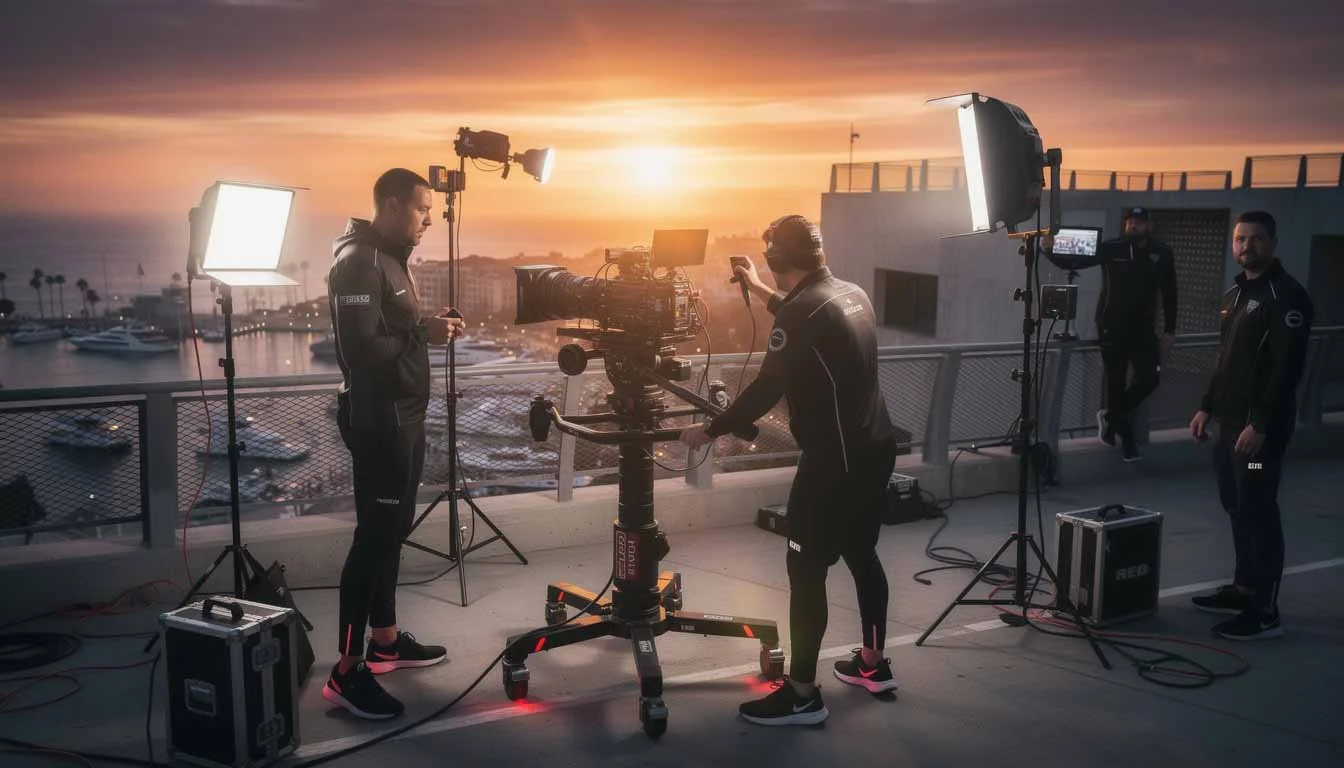
Production — One to two days of filming with cinema-grade equipment, proper lighting, and professional audio.
Post-production — Full edit, color grade, music licensing, motion graphics, sound design, and subtitles.
Social cuts — 15 and 30-second versions for paid social ads and pre-launch content.
Launch support — Thumbnail optimization, campaign page video placement guidance, and recommendations on how to use your assets across email and social leading up to launch day.
If a production company isn't offering most of this, you're getting a video without a strategy — and the strategy is what converts.
Building Beyond the Campaign
The best Kickstarter campaigns use the launch as a proof-of-concept and brand-building moment that carries forward into retail, DTC, or continued product development. The video assets produced for your campaign — with some additional planning — can serve your brand for 12 to 18 months beyond launch day.
For brands that keep building after a successful campaign, having a solid business profile video and ongoing product videography strategy are the natural next steps. It's worth having that conversation early so the initial production is designed with future assets in mind.
Ready to Build Your Kickstarter Campaign Video?
We're based in Newport Beach and have been producing Kickstarter videos since the platform launched. If your campaign is 60 to 90 days out, now is the right time to start.
Ready to start your project? Let's talk.
📞 Call or Text: +1 (949) 449-4472 ✉️ Email: director@hilomotionpictures.com 📍 220 Newport Center Dr. #11-248 | Newport Beach, CA 92660 🕐 Mon–Fri 8am–5pm | Sat–Sun 9am–4pm
